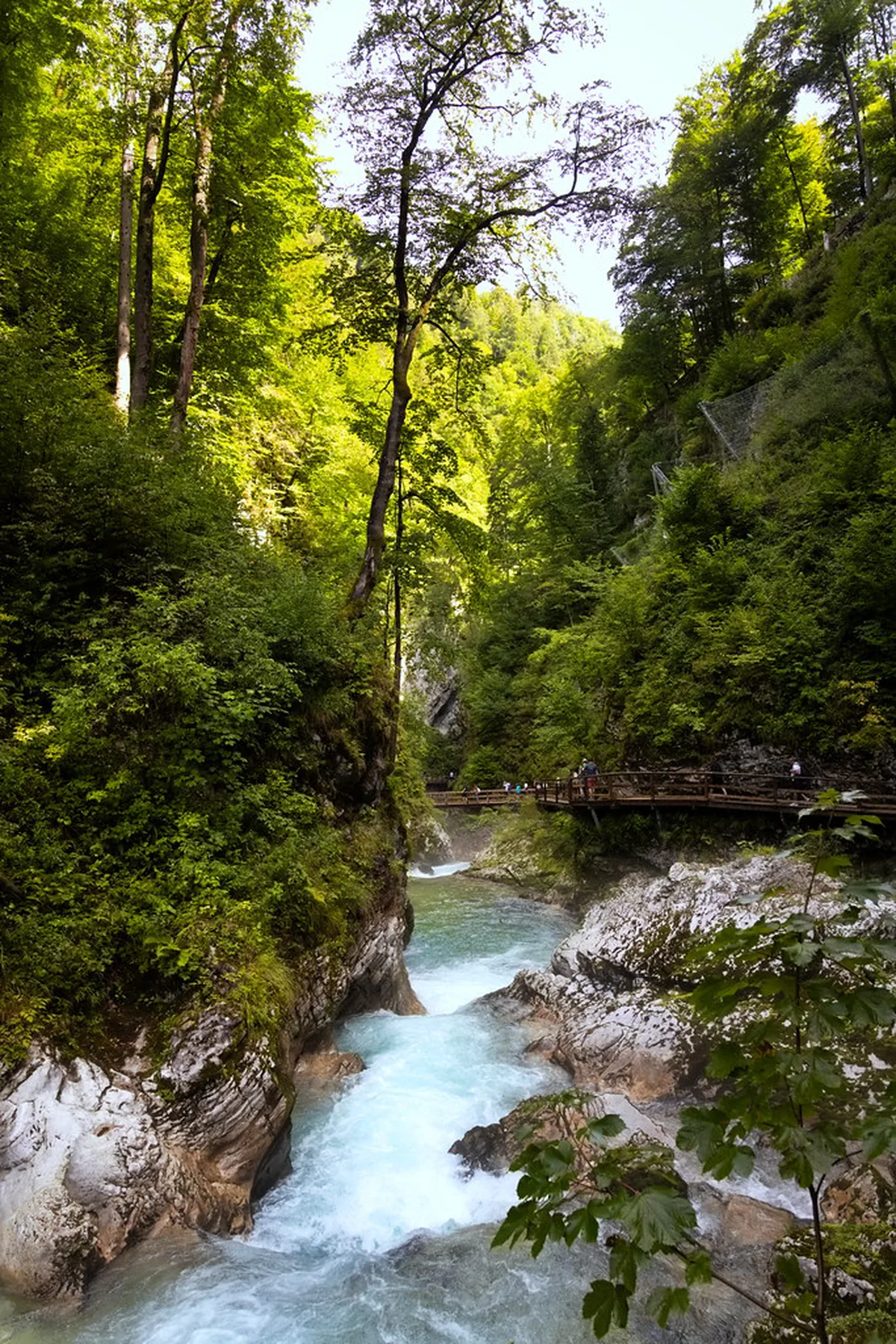
The Radovna River has been carving its way through the limestone foothills of the Julian Alps for millennia, and the result — Vintgar Gorge — is one of the most visually striking natural attractions in Slovenia. Located 4 kilometres northwest of Bled village, the gorge channels the river through a narrow canyon up to 30 metres deep, its walls dripping with moss and ferns, its floor filled with pools of turquoise and emerald water. A 1.6-kilometre series of wooden boardwalks, bridges, and gallery walkways follows the river upstream to the Šum waterfall. Opened to visitors in 1893, it remains one of the most-visited natural sites in the country — and for very good reason.
What is Vintgar Gorge?
Vintgar Gorge (Blejski vintgar, pronounced "VINT-gar") was formed by the Radovna River cutting through a band of Triassic limestone over thousands of years. The gorge walls — up to 30 metres high in the deepest sections — are sheer and closely spaced, in some places narrowing to just a few metres across. The confined channel accelerates and concentrates the river flow, creating a series of rapids, calm turquoise pools, and small cascades.
The gorge was discovered for tourism in the early 1890s by a local group including the mayor of Bled. The first wooden walkway was built in 1893, a remarkable feat of alpine carpentry that required anchoring wooden galleries directly to the canyon walls above the water level. The walkway system has been rebuilt and extended several times since; the current infrastructure follows the same route established over 130 years ago.
How to Get to Vintgar Gorge from Lake Bled
Vintgar Gorge is 4 kilometres from Bled village. There are four practical ways to get there:
Walking
The walk from Bled village to the gorge entrance takes about 50–60 minutes on a clearly marked footpath that follows the valley floor north through farmland and woodland. The route is well-signposted from the village centre. The path is relatively flat with only gentle gradients — suitable for most fitness levels. Combined with the gorge walk itself (1.5–2 hours), this makes a 3–4 hour round trip on foot from Bled.
Cycling
The same path is cyclable and takes about 20 minutes from the village. Bikes can be hired in Bled from approximately €15–20 per day. Note that bicycles must be left at the gorge entrance — the walkway through the gorge itself is too narrow for bikes. Cycling is a particularly good option for the return journey when you may want a faster route back.
Shuttle Bus (July and August only)
During the peak summer months of July and August, a dedicated tourist shuttle bus runs between the Bled bus stop and the gorge entrance. The shuttle runs roughly hourly; check the current schedule at the Bled tourist information office. This is the lowest-effort option for those who do not want to walk or cycle.
Car or Taxi
Drivers can reach the gorge via a narrow road from Bled village (follow signs for Vintgar). A car park near the gorge entrance charges a modest parking fee. The lot fills quickly on summer mornings; arriving before 9am is strongly recommended for drivers. A taxi from Bled takes about 10 minutes and costs approximately €8–12 one way.
The Wooden Walkway
The engineering achievement at the heart of the Vintgar experience is the wooden walkway itself. When the gorge was first opened to visitors in 1893, local enthusiasts built the initial wooden galleries directly into the canyon walls — anchoring timber supports to the sheer limestone face at heights of up to 10 metres above the river, in sections where the canyon floor was completely submerged. The current walkway follows the same 1.6-kilometre route but has been rebuilt and reinforced many times since, using the same principle: timber planks and bridges suspended on iron brackets fixed to the rock, clinging to the cliff face above the water.
In the deepest sections of the gorge, the canyon walls rise 30 metres on either side and stand only a few metres apart. The walkway runs at mid-height on the eastern wall, giving walkers a position above the rushing water with the full canyon depth visible below. Handrails run the full length; the walkway is fully fenced at exposed sections. Wet conditions make the planks slippery — non-slip soled shoes are strongly recommended.
The Walking Route Through the Gorge
💡 Pro Tip: Book your Bled adventures in advance through Viator for the best deals!
The walkway through the gorge is one-way from the entrance at the southern end to the Šum waterfall at the northern end. The route is 1.6 kilometres long and takes 45–60 minutes to walk through without stopping for extended photography; allow 1.5 to 2 hours if you want time to absorb the scenery properly.
The Entrance Section
The first few hundred metres of the walkway are the most dramatic. The canyon walls close in quickly and the wooden boardwalk clings to the rock face above the river. In several places the walkway is suspended over the water, with the river rushing directly below the boards. The walls are covered in vivid green moss and ferns fed by constant spray; the light is filtered and blue-green, refracted through the water.
The Middle Pools
Further along, the gorge opens slightly and the river forms a series of calmer, deeper pools. The water colour here — a clear turquoise deepening to dark green in the deeper sections — is the result of the limestone substrate and the water's mineral content. These pools are the most-photographed sections of the gorge. In summer the deep pools are cool enough that the air above them is noticeably chillier than outside the canyon.
The Bohinj Railway Bridge
About halfway through the gorge, a stone railway bridge crosses overhead — the historic Bohinj Railway line built in 1906, which still carries trains between Jesenice and Nova Gorica. The contrast between the ancient geological formation below and the century-old railway infrastructure above is a distinctive moment in the walk.
Šum Waterfall
The walk ends at the Šum waterfall, where the Radovna River drops approximately 13 metres over a wide limestone shelf into a turquoise pool below. Šum is one of the most powerful waterfalls in Slovenia by flow volume — not a tall, thin cascade but a wide curtain of water, loud and forceful, that fills the end of the gorge with spray and sound. The name comes directly from the Slovenian word for "noise" — at peak flow in April and May, when snowmelt from the Julian Alps is at its height, the falls are genuinely thunderous and visible spray reaches the observation point on the walkway.
The pool at the base of Šum is designated for swimming in the appropriate season. The turquoise colour results from the same limestone mineralogy that defines the gorge throughout — the water is clear and cold, considerably colder than the lake at Bled. Swimming is permitted in the designated areas adjacent to the pool; the main current in front of the waterfall itself is too strong for safe swimming but the calmer margins are accessible. A small refreshment stand operates near the waterfall in high season. Arriving at the falls at the end of a hot July walk, with the option to cool down in the pool before beginning the return, is one of the gorge's most satisfying sequences.
Extending the Walk: Beyond Šum
Most visitors treat the Šum waterfall as the end point and return to Bled via the valley path above the gorge — a pleasant 45-minute walk through open meadows that offers a complete contrast to the enclosed canyon. But there are options for extending the day if you have time and energy.
From the top of the valley return path, a trail leads to the village of Zasip, approximately 3 kilometres from the gorge exit. Zasip is a quiet Slovenian farming village with a small church and traditional architecture — a good place to stop for water before continuing or turning back. The route from the gorge to Zasip adds roughly 45 minutes to the overall walk and is accessible to any competent walker in suitable footwear.
An alternative loop route passes St. Catherine's Church (Sv. Katarina), a small medieval church on a hillside above the valley, adding about 30 minutes to the standard valley return. The church dates from the 15th century and is often unlocked; the hillside position gives views toward Bled and the lake. This route is well-marked with Slovenian hiking signs (yellow and white) from the gorge exit. Combined with the gorge walk and the path from Bled, the full extended loop — Bled village to gorge to Zasip or St. Catherine's and back — totals approximately 12–14 kilometres and makes a solid half-day mountain walk.
How to Photograph Vintgar Gorge
The gorge presents specific photographic challenges. The light inside the canyon is low and indirect, so a wide aperture or increased ISO is needed to avoid motion blur on the water. Early morning (before 9am) offers the most even light without direct sunlight creating harsh contrasts between the lit water and the shadowed walls. A polarising filter reduces surface reflections on the pools and brings out the turquoise colour more accurately. Wide-angle lenses work better than telephoto in the confined space. The most compelling shots are typically of the suspended boardwalk sections, where the human scale against the canyon walls emphasises the gorge's depth.
Vintgar Gorge with Children
💡 Pro Tip: Book your Bled adventures in advance through Viator for the best deals!
The gorge is one of the more child-friendly natural attractions in the region. The walkway is fully fenced and the one-way routing means no navigational decisions are required. Children generally find the deep pools, narrow passages, and suspended walkways genuinely exciting rather than just scenery to be photographed. The gorge is pushchair-accessible in its wider sections but not throughout — a baby carrier is more practical for the narrower parts. The total walking distance (3.2km return via the valley path) is manageable for most children aged 5 and above.
Best Time to Visit Vintgar Gorge
The gorge is open from April through November; it is closed December through March due to ice risk on the walkways. Each season offers a distinct experience:
- April and May: Peak water flow from snowmelt makes the Šum waterfall most impressive and the pools most vivid. Few crowds. The valley path back is lined with spring wildflowers.
- June and September: Ideal balance of good light, manageable crowds, and stable conditions. Recommended for most visitors.
- July and August: Peak crowds — the walkway becomes congested between 10am and 3pm. Arrive before 9am or after 4pm. Water temperatures in the pools are coolest in these months despite warm air temperatures, making the canyon refreshingly cool.
- October and November: Autumn colours on the valley trees above the gorge are exceptional. Water levels drop and the pools are clearest. Very few visitors.
Practical Information for 2026
- Admission: ~€10 per adult; children typically half-price or free depending on age
- Opening season: April through November (closed December–March)
- Opening hours: 8am–7pm in peak season (July–August); check current hours in shoulder months
- Distance from Bled: 4km
- Walk time through gorge: 45–60 minutes one way; 1.5–2 hours at a relaxed pace
- Return route: Valley path above the gorge back to Bled (~45 min on foot) or same route (gorge does not permit two-way walking)
- Footwear: Sturdy non-slip shoes recommended; the boardwalk is wet in places
- Best timing: Before 9am or after 4pm to avoid peak crowds
- Facilities: Toilets at entrance; refreshment stand near Šum waterfall in season