Butrint National Park from Ksamil: Complete Visitor Guide 2026
Twelve kilometres south of Ksamil, the road passes through olive groves and wetlands before arriving at a wooded peninsula above the Vivari Channel. This is Butrint — one of the most significant ancient sites in the Balkans and one of the most rewarding half-day trips you can make from anywhere on the Albanian Riviera.
For a complete overview, see our Ksamil Albania travel guide.
Butrint has been continuously occupied for more than two thousand years. Greek colonists, Roman administrators, Byzantine bishops, Venetian fortress-builders, and Ottoman rulers have all left their mark on this compact peninsula, stacking layers of construction on top of each other so densely that archaeologists are still untangling what belongs to which era. A UNESCO World Heritage site since 1992, Butrint rewards visitors who take their time and look carefully at what they're walking through.
Getting to Butrint from Ksamil
The 12-kilometre journey from Ksamil to Butrint is straightforward. The most common options are:
Taxi from Ksamil
A taxi from Ksamil to Butrint costs approximately 800–1200 ALL one way and takes around 15 minutes. Most drivers will offer a return fare with waiting time — typically 2500–4000 ALL for the round trip including two to three hours at the site. Negotiate the price before you get in and confirm the waiting arrangement clearly.
Rental Car or Scooter
If you have a rental car or scooter, the drive to Butrint from Ksamil takes about 15 minutes on a paved road. Parking at the site entrance is free. A scooter makes this trip particularly pleasant — the road passes through quiet countryside with views over the Vivari lagoon system and occasional sightings of flamingos in the wetland areas.
Organised Tour
Several guesthouses and tour operators in Ksamil and Saranda offer organised day trips to Butrint, sometimes combined with a visit to the Blue Eye spring or Gjirokastër. These are convenient if you want a guided explanation of what you're seeing, as the site's layers of history benefit from interpretation. Costs vary from around 2000–5000 ALL per person depending on inclusions.
Butrint Tickets and Opening Hours 2026
Admission to Butrint National Park in 2026 is approximately 700 ALL (around 7 EUR) for adults. Reduced rates apply for children and students. The ticket includes access to the entire archaeological site and the site museum near the entrance.
The park is open daily from approximately 8:00am to 7:00pm in summer (May–September). In the off-season (October–April) opening hours are reduced, typically 8:00am to 4:00pm or 5:00pm. Always confirm current hours before visiting, as they can vary slightly between seasons and years. There is no formal lunch closure.
A small shop and café operate near the entrance in peak season. Beyond the entrance complex, there are no food or drink facilities within the site, so bring water — particularly important in July and August when the wooded paths can feel humid despite the shade.
What to See at Butrint: The Ruins
The Lion Gate
One of the oldest surviving structures at Butrint, the Lion Gate is an original Greek fortification from the fourth or third century BC. The carved relief of a lion above the gate is one of the most reproduced images from ancient Albania. It marks the entrance to the acropolis area and sets the tone for a site where every other wall or archway has a backstory spanning multiple civilisations.
The gate's lintel carries the lion carving in high relief — the animal shown in profile, with a serpent or bull beneath its paws in some interpretations. It is a talismanic guardian image typical of Hellenistic city gates of this period. The stonework of the surrounding walls shows the careful polygonal masonry technique favoured by Greek builders, where irregularly shaped stones are fitted together without mortar. Look closely at the joints — the precision is remarkable given the tools available in the third century BC. The gate originally controlled access from the lower settlement to the elevated acropolis, a position that commanded views over the entire peninsula and the waterway below.
The Roman Theatre
The theatre at Butrint dates to the first or second century AD and is remarkably well preserved. Carved into the hillside in typical Roman fashion, it originally seated around 2,500 spectators. The limestone seating tiers are largely intact, and it is easy to visualise the space in use. The theatre is one of the most photogenic spots at Butrint — light in the late morning falls across the seating rows in a particularly striking way.
The Baptistery Mosaic
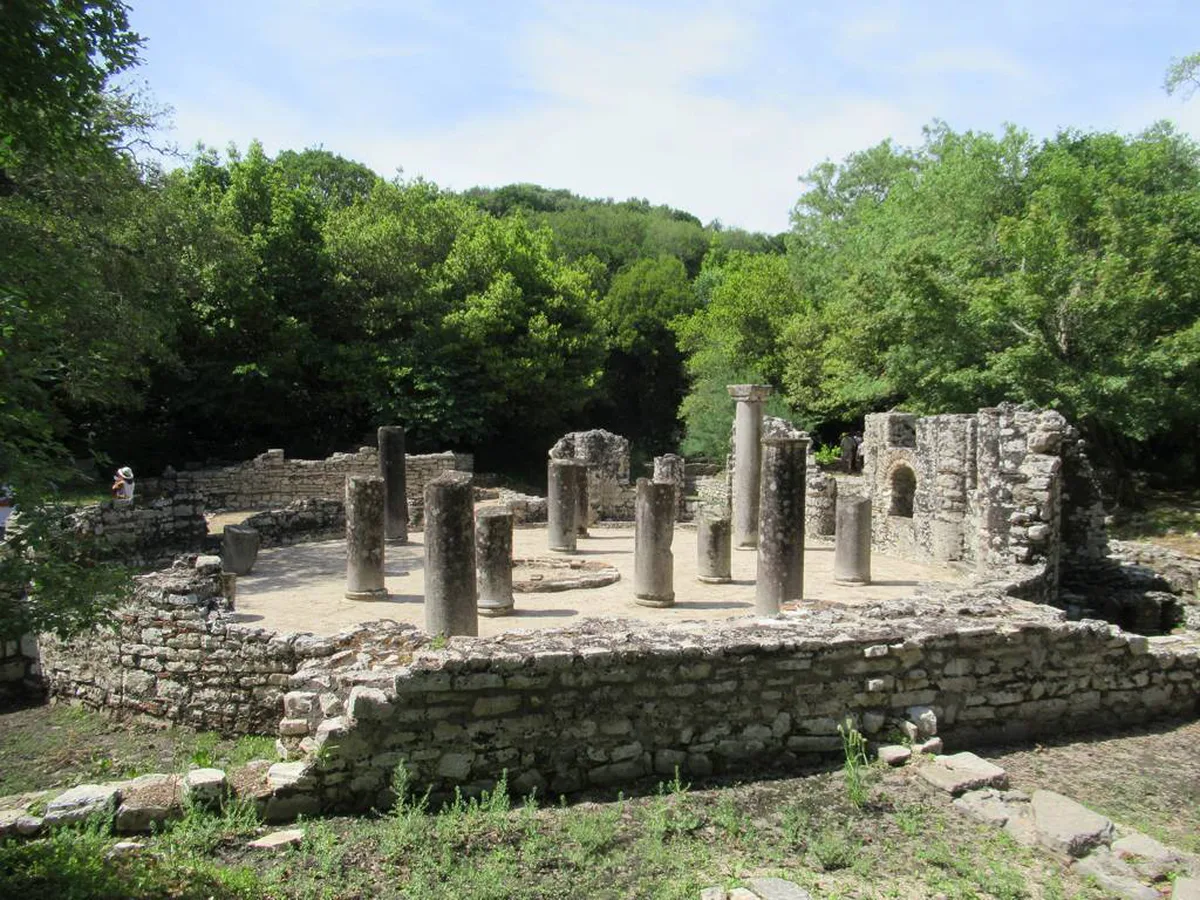
The baptistery is the highlight of the Byzantine section of Butrint and, for many visitors, the single most remarkable thing at the site. Dating to the sixth century AD, it contains one of the largest and best-preserved early Christian mosaic floors in the world — an intricate geometric carpet of coloured stone covering the entire floor of the circular baptismal hall. The mosaic is protected by a wooden cover for most of the year to prevent weather damage; the cover is sometimes removed for viewing on request or during managed visiting periods. Even viewing it through the slats is impressive.
The Venetian Towers
The Triangular Fortress and the Ali Pasha Fortress visible across the Vivari Channel both date to the Venetian period of the fifteenth and sixteenth centuries, when Butrint was an important strategic outpost on the edge of Venetian territorial control. The towers are not always open to climb but their silhouette above the treeline adds a medieval drama to the site's overall atmosphere.
The Byzantine Basilica
Adjacent to the baptistery, the remains of a large Byzantine basilica give a sense of how significant Butrint was as an early Christian administrative centre. The floor plan of the basilica is extensive — the building would have been one of the largest structures at the site during the fifth and sixth centuries. Fragments of decorative stonework and column bases are scattered around the perimeter.
The basilica was built in the fifth century AD as part of a larger episcopal complex — Butrint was the seat of a bishop during the Byzantine period, which explains the investment in such an ambitious religious building on what is, geographically, a relatively small peninsula. The nave extended approximately 35 metres in length; you can trace the full outline by following the foundation walls. Carved marble capitals from the original colonnade are visible near the east end of the site, some bearing decorative vine-scroll patterns characteristic of early Byzantine stone carving in the Balkans. The relationship between the basilica and the baptistery — positioned at the western end of the complex — follows the liturgical layout standard for episcopal churches of this era, where catechumens were baptised before being permitted into the main church for the Eucharist.
The Venetian Fortress Tower
The Ali Pasha Fortress and the Triangular Fortress, both dating to the Venetian period of the fifteenth and sixteenth centuries, are the most visually dramatic structures at Butrint when viewed from the channel path. Venice controlled Butrint as part of its Adriatic and Ionian strategic network from the early fifteenth century, and the fortress towers reflect the military engineering priorities of the period — thick walls, narrow gun ports, elevated firing platforms, and a position commanding the Vivari Channel narrows.
The Triangular Fortress sits at the tip of the Butrint peninsula and is one of the best-preserved Venetian structures in Albania. Its corner bastions were designed to accommodate early artillery — the angled walls deflect cannon fire more effectively than straight medieval walls. The Ali Pasha Fortress is across the channel (visible but not always accessible on a standard site visit) and dates partly to the Venetian era with later Ottoman-era modifications under Ali Pasha of Ioannina in the early nineteenth century. Together the two fortifications controlled one of the most strategically important waterway pinch-points on the eastern Adriatic coast.
The Vivari Channel Views
As you walk the northern edge of the Butrint peninsula, the Vivari Channel opens up on the left — a narrow waterway connecting the Butrint lagoon to the sea. The views across the channel to the opposite bank, and south toward the open coast, provide excellent context for understanding why this site was strategically important to every civilisation that occupied it. The wooded banks and the stillness of the water make this one of the more atmospheric spots at Butrint, particularly in the late afternoon.
The Site Museum
The museum near the entrance houses finds from the Butrint excavations — pottery, coins, carved stonework, and explanatory panels tracing the site's history from the Greek period through to the Ottoman era. It is modest in size but the artefacts are genuine and well-presented. The museum is worth visiting before entering the main site to give yourself an interpretive framework for what you'll see.
Self-Guided Tour Route at Butrint
⭐ Recommendation: Don't miss out on amazing Ksamil tours - book now!
Butrint's layout is more logical than it first appears. Follow this sequence to see the main highlights in a natural order that minimises backtracking and makes sense chronologically:
- Site Museum (entrance area) — 15 minutes. Visit the museum immediately on entry. The artefacts and timeline panels establish the chronological framework for what you will see outside. Without this context, the layers of construction on the main site can feel confusing.
- Lion Gate and city walls — 10 minutes. From the museum, head up the path toward the acropolis. The Lion Gate is the first major structure. Examine the polygonal masonry of the surrounding walls and the carved lintel before passing through.
- Roman Theatre — 15 minutes. A short walk from the Lion Gate, the theatre sits carved into the hillside. Climb the upper seating tiers for a view over the tree canopy toward the channel. The acoustics are striking — speak from the stage area and listen.
- Baptistery and Byzantine Basilica — 20 minutes. Continue down the main path to the baptistery complex. Peer through the wooden cover slats to see the mosaic floor. Walk the full perimeter of the basilica foundation walls to appreciate the scale of the building.
- Venetian Triangular Fortress — 10 minutes. Continue south to the tip of the peninsula and the Triangular Fortress. The view from the tower (when open) across the channel to the Ali Pasha Fortress is one of the best vantage points at the site.
- Channel path walk — 20 minutes. Return along the northern edge of the peninsula, following the Vivari Channel path. This is the best section for birdwatching and the most atmospheric stretch of the whole site — wooded, quiet, and with open water views. End back at the entrance area.
Total time for this route: approximately 90 minutes at a comfortable pace, not including the museum. Add 30–45 minutes if you want to linger at each structure, read all the information panels, or spend time in the museum. The route is approximately 2 kilometres in total distance on uneven terrain.
Biodiversity: What Else Lives at Butrint
Butrint National Park is not only an archaeological site. The surrounding landscape — lagoons, wetlands, oak and olive woodland, and the channel — supports a rich variety of wildlife. The Butrint lagoon complex is an important bird habitat, with flamingos, herons, cormorants, and numerous wading bird species present throughout the year. Loggerhead sea turtles nest on the nearby coast. The woodland within the park itself is home to foxes, otters, and a wide range of reptiles.
If you have an interest in wildlife, the walk around the perimeter of the park along the channel path is particularly rewarding in the early morning, when birds are most active and human visitors are scarce.
How Long to Spend at Butrint
Allow a minimum of two hours to see the main highlights at a reasonable pace. Three hours is more comfortable and allows time to read the information panels, explore the museum, walk the channel path, and sit in the theatre without feeling rushed. Half a day from Ksamil (including transit) is the ideal allocation.
The site involves significant walking on uneven surfaces — cobblestones, stone steps, gravel paths, and occasional bare rock. Comfortable walking shoes with a grip sole are strongly recommended. Sandals are manageable for the paths but not ideal for the stone steps in the theatre and fortress areas.
What to Bring
⭐ Recommendation: Don't miss out on amazing Ksamil tours - book now!
- Walking shoes with grip soles
- Water (at least 1.5 litres per person in summer)
- Sun protection — the park has tree cover but exposed sections in the middle of the day can be hot
- Cash in ALL for the entrance ticket
- Camera or charged phone — there are numerous outstanding photo opportunities
- Insect repellent — the lagoon-adjacent paths can attract mosquitoes, particularly in the evening
Combining Butrint with Other Stops
Butrint pairs well with other day trips from Ksamil. If you have a taxi or rental car, combining Butrint (morning visit, 8am–11am) with the Blue Eye spring (afternoon, 30km north) makes an excellent full-day excursion. Alternatively, Butrint is a natural first stop on the road to Gjirokastër, which lies approximately 80 kilometres to the northeast via the Gjirokastra valley road.
In this guide: