
How to Find a Paris Cemetery Burial Record Before a Visit
Trace a name from the Archives de Paris annual index to the daily burial register, then use the entry to ask where a family grave stands today.
On this page
Before travelling to look for a family grave in Paris, look up the surname in the annual index, then follow the entry into the daily register. That register can tell you where someone was buried, while locating a grave you can visit today takes a separate inquiry.
Start with a surname and an approximate year
Start with a family document that puts the person in Paris at a particular time. A memorial card may give you a death date, while a letter may name the cemetery where relatives attended the burial. Copy the wording that identifies the event. For example, a Paris address under a relative’s signature tells you where that relative lived. Leave the cemetery field open unless something on the document actually identifies the burial place.
| What you already have | Where to look next |
|---|---|
| Surname and approximate burial year | Go straight to the annual cemetery index. Keep any alternative spelling beside you as you search. |
| Married name missing from a family note | Look for the spouse’s surname in a family record book or marriage record before ruling out an index match. |
| Death date but no cemetery | Use the year to find candidate indexes. Read the entries for each cemetery returned in the results. |
Search the annual burial index by surname and year
Open the Archives de Paris annual indexes and select “Consulter les répertoires annuels d’inhumation.” The digitized burial registers cover 19 of its 20 municipal cemeteries, with partial coverage from 1804 to 1975. Calvaire has no register in this collection. Search under the likely burial year, especially if a death occurred close to New Year’s Day. In that case, try the following year as well.
- For a surname with spaces, enter its first few letters. The archive indexes compound surnames without spaces, so a family spelling such as Le Chevalier can appear as Lechevalier.
- For a married woman, try her married surname first. Women generally appear under that name in these indexes. Keep her birth surname available for a second search.
- If several cemeteries appear, open each relevant index and record where you searched. A family connection to Père-Lachaise is a lead worth testing, but it does not establish where this person was buried.
Copy the 3 details that lead to the daily register
Beside a matching name, the annual index gives you a date and a registration number. Carry 3 details from that search into your notes. Keep each candidate’s details together when several people share the surname. Mixing a date from one line with the number from another can lead you to a plausible entry for the wrong person.
- Cemetery name. Copy it from the index you actually opened, even if it differs from the place mentioned by your family.
- Date and its meaning. Look for “inhumation” for burial or “décès” for death. Preserve that distinction when you transcribe the date.
- Registration number. Copy the numéro d’ordre from the same line as the name. It identifies the entry in the register and has no use as a plot number on a visitor map.
Read the entry in the daily burial register
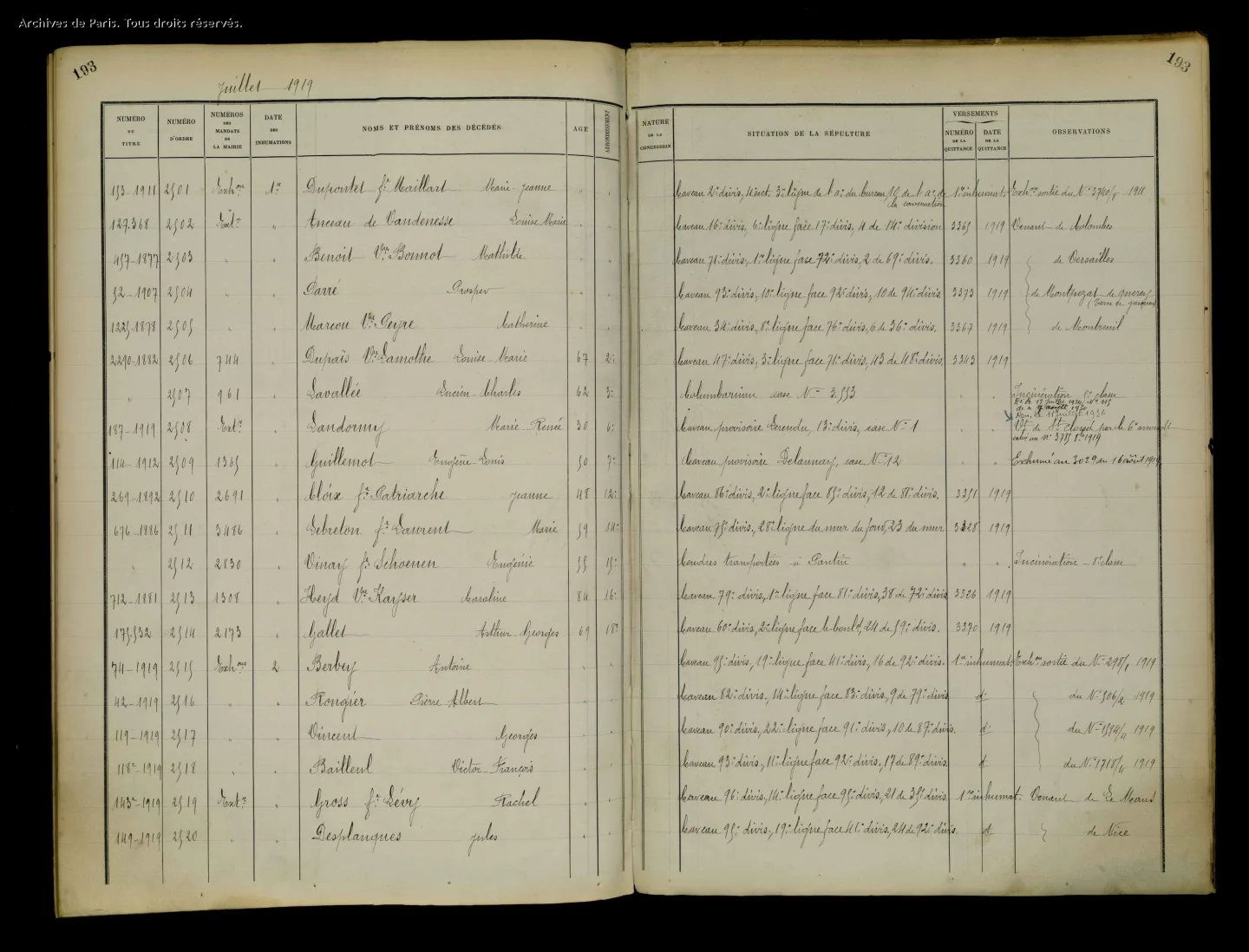
Open the Archives de Paris daily burial registers and select the matching cemetery. Enter the burial date in day/month/year order if you have it. When the index gives a death date instead, select the likely year range and find the registration number inside the volume. Compare the age or place of death in that entry with a detail you know independently. Resolving a shared name here can save you a trip to the wrong cemetery.
- Read across the full entry to the burial location. Copy the location wording exactly, including any division or other reference that appears.
- Look for the duration of the concession, the right to use the burial plot. A temporary concession is particularly good reason to ask about the plot’s later history.
- Save an image with the column headings visible. Include the volume reference and image number in your notes so you can reopen the page if a handwritten word proves difficult to read.
Find out whether the family grave can be visited today
Treat the location in the daily register as the address of the burial on that date. Even a clear entry leaves open what inscription, if any, you would find there today. For a family grave, the City of Paris central cemetery service holds concession records and burial or exhumation files. Use the Archives de Paris instructions for family inquiries to find the responsible office and check the documents it requests. Ask specifically for the present location of the grave and the reference you should use on site.
Use the cemetery map once you have a location
If the reply identifies a division at Père-Lachaise, use the Père-Lachaise gates and map guide to choose your entrance. Check the city’s current Père-Lachaise plans before setting out. Bring the reply alongside the historic register image so you can show both if you need directions. Where the archive establishes only that a burial took place, plan your stop as a visit to the cemetery. Save the search for a particular headstone until you have a present-day location.
The featured image shows a page from the Père-Lachaise daily burial register. Each row belongs to a separate entry. Image credit: Mairie de Paris, Archives de Paris. Public-domain register scan.
