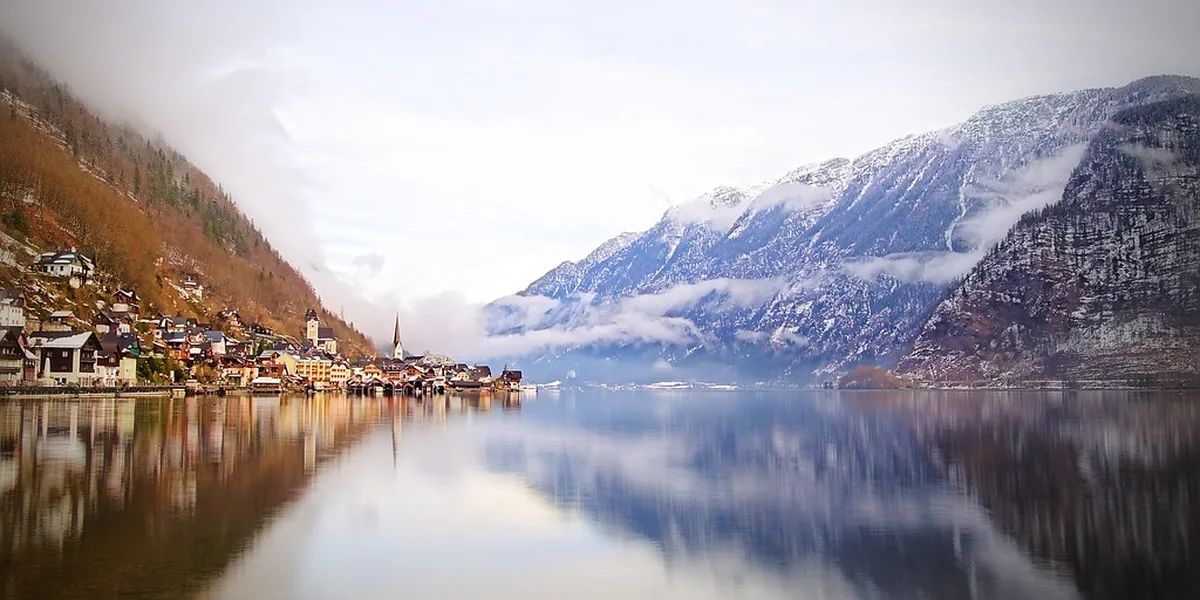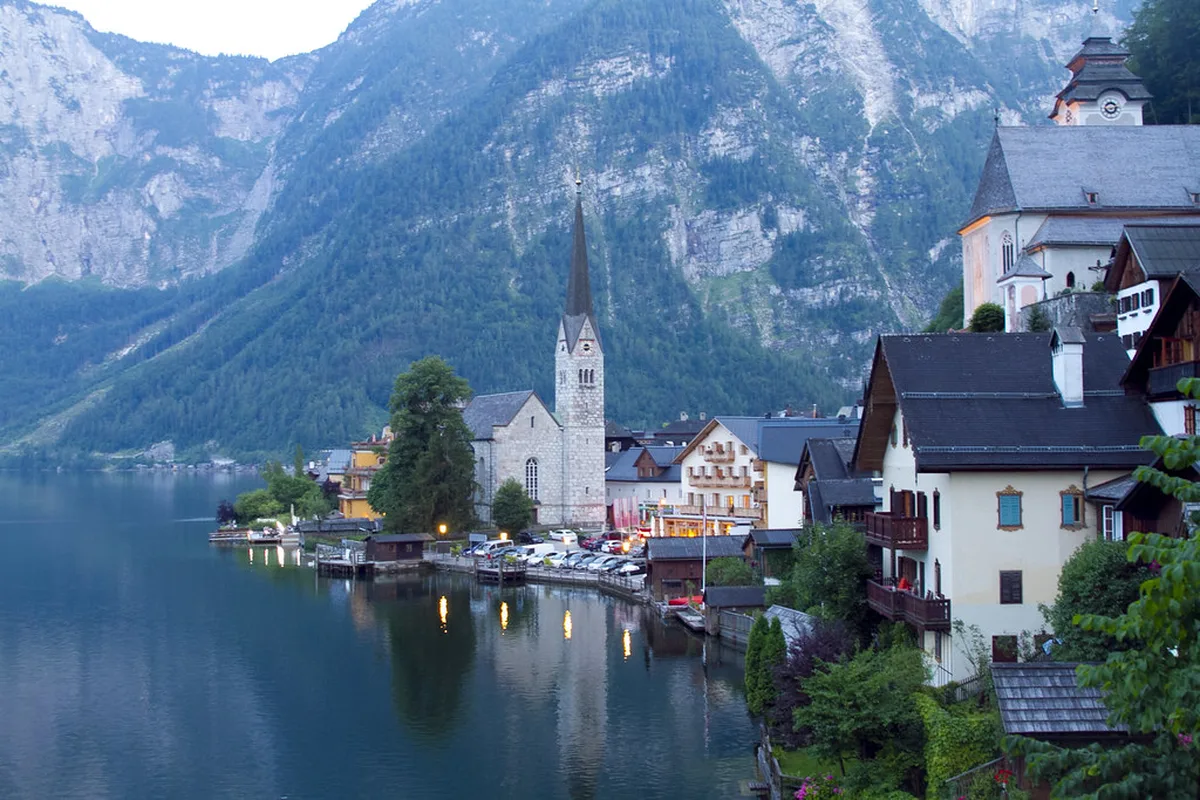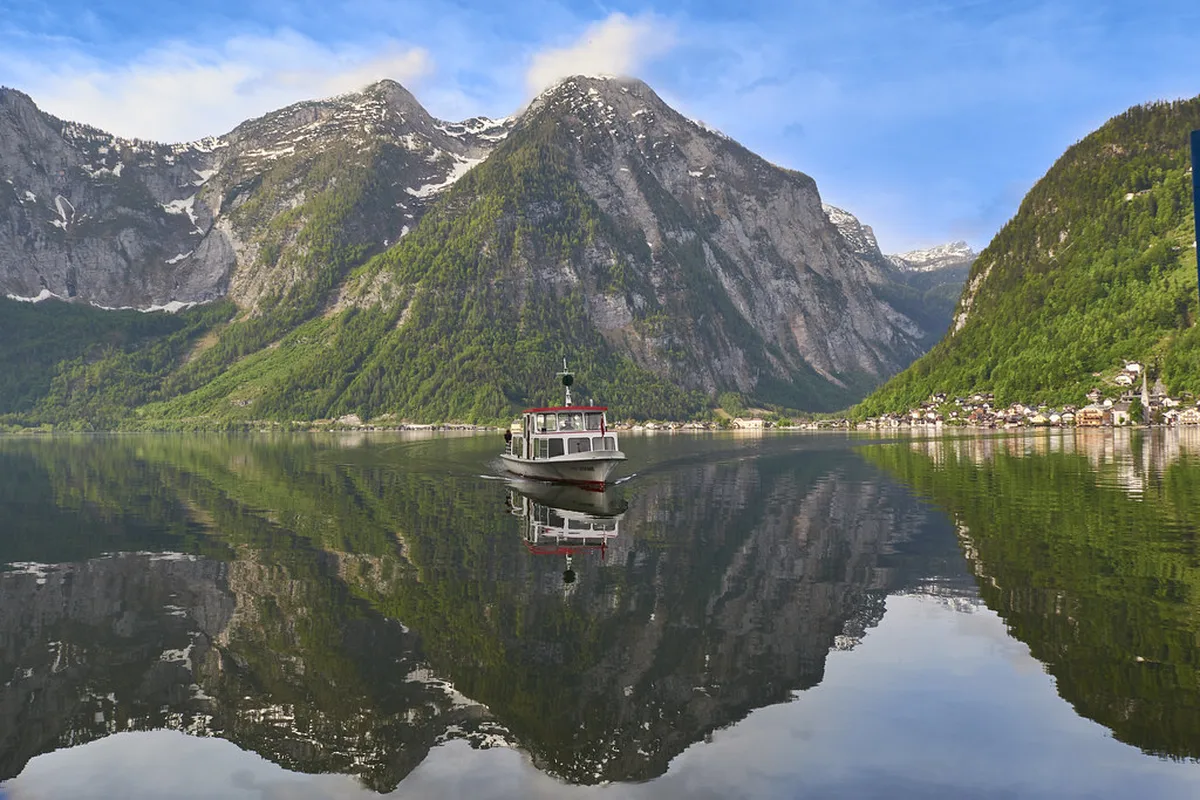
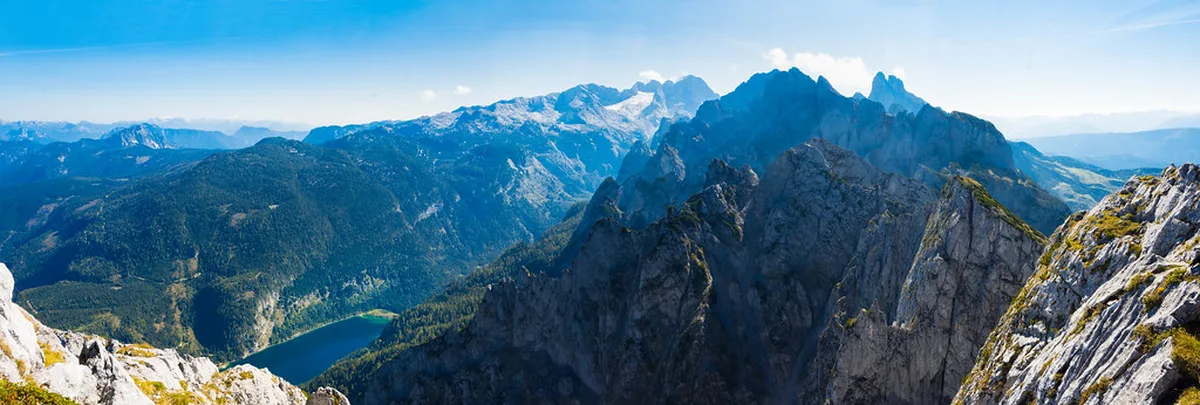
The Hallstatt Skywalk — officially called the World Heritage View — is an observation platform built into the cliff face of the Salzberg mountain, several hundred metres above the village. From it, the entire geography of Hallstatt becomes visible at once: the narrow strip of land on which the village is built, the dark-green Hallstätter See stretching to the south, the mountain walls rising on every shore, and the red and white rooftops of the houses clustered around the church spire far below.
For a complete overview, see our Hallstatt Austria travel guide.
It is a different and complementary view to the famous dock photograph. Where the dock view shows the village's face — the church reflection, the coloured facades — the Skywalk reveals its setting: the drama of a village squeezed between cliff and lake in a deep Alpine valley.
Step-by-Step Directions from the Village to the Funicular Station
The walk from the centre of Hallstatt to the funicular station takes approximately 12–15 minutes on foot and is straightforward once you know the route. The village is compact enough that getting lost is unlikely, but the signage between the market square and the funicular station is not always immediately obvious.
- Start at the Marktplatz (market square). This is Hallstatt's central hub, in front of the parish church and the museum. Orient yourself with the lake on your left (west) and the cliff face behind you (east).
- Walk south along the lake promenade. Follow the lakeside path heading south from the market square. The lake remains on your right as you walk. You will pass the main concentration of cafes and small hotels along this stretch.
- Continue past the Lahn car park area. After approximately 10 minutes, you reach the Lahn district at the southern end of the village — a wider, more open area with the main car park and the bus terminus. This is where coaches drop passengers and where many visitors park if arriving by car.
- Follow the signs to the Salzbergbahn. From the Lahn area, look for signage to "Salzbergbahn" or "Salzwelten" — both point to the same funicular station. The station building is a few minutes' walk from the car park, slightly uphill and inland from the lake.
- Join the queue at the funicular station. In peak summer, a queue forms from approximately 9am onward. The funicular carries groups continuously throughout operating hours. Buy tickets here or present pre-purchased tickets.
Total walking time from market square to funicular station: approximately 12–15 minutes at a normal pace. Allow more time in peak season if the promenade is very busy.
How to Reach the Hallstatt Skywalk
The Skywalk is not accessible on foot from the village below without a significant climb. The practical route for most visitors involves the Salzbergbahn funicular, which departs from the southern end of Hallstatt near the Lahn district. The funicular ride takes approximately five minutes and delivers passengers to the Salzberg station at around 855 metres above sea level.
From the Salzberg station, the Skywalk platform is a 10-minute walk along a marked path through the forest. The path is relatively level once you leave the funicular station and is suitable for most visitors, including older travellers and those with young children, provided they are comfortable on natural terrain with some uneven sections.
The funicular station is clearly signed from the village. From the market square, walk south along the lakeside and past the main car park at Lahn — the funicular station is at the far southern end of the village. In peak season, a queue for the funicular is common from mid-morning onward.
Funicular Cost and Opening Hours in 2026
The Salzbergbahn funicular operates year-round, though hours vary by season. In summer (May to October), the funicular typically runs from approximately 9am to 6pm. In winter, hours are reduced and the funicular may close temporarily in poor weather or when the Skywalk path is icy.
A return ticket on the funicular costs approximately €13 per adult in 2026. Children travel at reduced rates. The funicular is also included in the combined salt mine and funicular ticket (approximately €35), making it cost-effective to combine the Skywalk visit with the mine tour on the same ascent.
The Skywalk platform itself has no additional entry fee beyond the funicular ticket.
Best Time to Visit the Hallstatt Skywalk
🎯 Insider Tip: Discover the best Hallstatt experiences with Viator Tours!
The single most important variable affecting the Skywalk experience is the time of day. In July and August, the first funicular of the morning is at around 9am and immediately draws visitors. By 10am, the platform and the path to it are busy. By midday, they are crowded. The platform, while large enough for a reasonable number of people, loses much of its atmosphere when packed.
The optimal strategy in summer is to take the first or second funicular of the day — typically the 9am or 9:15am — and walk directly to the Skywalk before the bulk of day-trippers arrive. At 9am, the morning mist may still cling to the lake surface and the mountains, producing an atmospheric quality that midday sunshine eliminates. By 9:30am on the platform, you may still have relative peace.
Outside of summer peak season — from October through May — the Skywalk is rarely crowded even at midday. Visiting in late October or early November means the deciduous trees on the Salzberg have turned gold and orange, framing the view with autumn colour. In winter, snow on the platform and on the village rooftops below creates a entirely different and often more striking image than the green summer version.
What You See from the Skywalk Platform
The platform faces roughly west-northwest, with the main viewing area angling toward the village and the lake. The view encompasses:
- The full length of the Hallstätter See, stretching approximately 8 kilometres south from the village
- The compact layout of Hallstatt village directly below, showing how tightly it is confined between the cliff base and the water
- The parish church tower — the white spire of the Catholic Pfarrkirche — visible from above as the clear focal point of the village's roofscape and the landmark by which the village is identified in every photograph
- The Dachstein massif to the south: a wall of limestone more than 2,900 metres high that forms the visual anchor of the entire Salzkammergut. On clear days the Dachstein glacier — the Hallstätter Gletscher — is visible as a white smear on the upper rock face above the treeline, approximately 20 kilometres distant
- The Hallstatt Bahnhof train station on the opposite (eastern) shore of the lake, a small cluster of buildings at water level connected to the village by the passenger ferry crossing a channel approximately 300 metres wide
- The Gosau Valley opening to the southwest, visible as a break in the mountain wall through which the road to Gosau passes — a useful orientation point for understanding the broader geography of the region
The view is framed by trees on both sides, which adds to its drama and gives it a more intimate quality than a completely open platform would. In summer the foliage is dense green; in autumn it becomes a multi-coloured frame for the lake and village below.
Photography Tips for the Skywalk
The platform faces roughly west, which means afternoon light falls on the village facade and the lake surface — the opposite of the dock view, which is best in the morning. The best light for photography from the Skywalk is in the late afternoon, from about 3pm onward in summer, when the sun drops toward the mountains behind you and illuminates the village and lake with warm, low-angle light.
However, the crowd situation means that early morning — when the light is less ideal — may produce better photographs simply because the platform is less occupied. The compromise is visiting on a weekday in shoulder season when both crowd levels and light are manageable.
A wide-angle lens or smartphone at maximum wide captures the full scope of the view — the lake from end to end and the mountains on both sides. A short telephoto (50–85mm equivalent) isolates the village cluster and the church spire from above, which makes a strong compositional alternative to the panorama shot.
Mist on the lake surface, common in the morning and after rain, adds significant atmosphere. Overcast light produces richer, more even colours than harsh midday sunshine. The platform railing is low and unobtrusive enough that it does not disrupt most compositions.
Equipment Notes
Smartphones perform well at the Skywalk because the primary shot is a landscape at infinity — there are no close-focusing challenges, and modern smartphone lenses handle the wide field of view naturally. For those carrying a camera, a zoom lens covering 24–105mm (full-frame equivalent) handles every shot on the platform: wide for the panorama, short telephoto for isolating the church spire, and mid-range for the village-and-mountains composition that most visitors default to.
A small travel tripod is worth carrying if you plan to shoot in the early morning or in low-light autumn conditions. The platform has a solid railing that can substitute as a brace in a pinch, but a tripod gives cleaner long-exposure results for misty lake shots. A polarising filter cuts glare on the lake surface and deepens the blue sky in midday shots — useful in July and August when the sun is high and the lake surface reflects brightly. In winter, lens cloths and a UV filter protect against windblown moisture on the platform.
Combining the Skywalk with the Salt Mine
🎯 Insider Tip: Discover the best Hallstatt experiences with Viator Tours!
The Salzberg station serves both the Skywalk viewpoint and the Hallstatt salt mine. The mine entrance is a short walk from the station in a different direction from the Skywalk path. The combined ticket covering both funicular and mine tour (approximately €35 in 2026) is the standard approach for visitors doing both on the same day.
A logical itinerary: take the first funicular up, walk to the Skywalk before the crowds build, return to the station for the mine tour at your booked time, then descend by funicular in the early afternoon. This sequence uses the Salzberg station efficiently and avoids returning to the funicular queue multiple times.
Hallstatt Salt Mine guideThe Skywalk in Winter
The Skywalk path can be icy and snow-covered in winter. The funicular operator typically maintains the path and the platform, and winter visits are possible — but check conditions before ascending in January and February. Snow on the Salzberg trail combined with the view of a snow-covered village below is one of the most atmospheric versions of the Hallstatt experience available.
In winter, opening hours are reduced. Verify current hours on the official Salzwelten or Hallstatt.net websites before visiting. The Christmas period (late November through early January) sees the village busy again — the Christmas market below and winter photography draw visitors even in cold months.
Is the Hallstatt Skywalk Worth It?
For most visitors, yes. The elevated view of Hallstatt is substantially different from the dock view and provides a perspective that makes the whole geography of the place intelligible. If you have committed to visiting Hallstatt, spending €13 to see it from above — in addition to the famous view from below — is a reasonable investment of both time and money.
Those with limited time (a single morning, for instance) who must choose between the dock view, the Skywalk, and the salt mine should probably prioritise in that order: the dock view is free and iconic, the Skywalk adds significant context, and the mine is the longest time commitment but the richest historical experience. All three together require a full day.